Guide Hub 360
It's Not Defiance — The Low-Demand Playbook for Parenting a PDA Child
It's Not Defiance — The Low-Demand Playbook for Parenting a PDA Child
Couldn't load pickup availability
Your child isn't giving you a hard time. Their nervous system is giving them a hard time.
You've tried the sticker charts. You've tried consequences. You've tried being firmer, and you've watched it make everything worse. You've been told your child is manipulative or spoilt or that you're too soft — usually by people who've spent an hour with them, not a lifetime.
For a child with a PDA profile, an ordinary request — put your shoes on, come to the table, brush your teeth — doesn't land as a request. It lands as a threat to their control. The body responds the way it would to danger. That's why they refuse things they genuinely want to do.
This is a complete, printable system for lowering the pressure at home so cooperation becomes possible again. You stop deciding from scratch in the heat of the moment — the response is already chosen, written down, and calmly repeated.
Why You Need This Guide:
- ✅ Finally makes sense of a child who refuses even the things they want to do — the driver is anxiety and a need for control, not defiance
- ✅ Explains what PDA autism parenting actually asks of you, and why sticker charts, consequences, and "just be firmer" keep making things worse
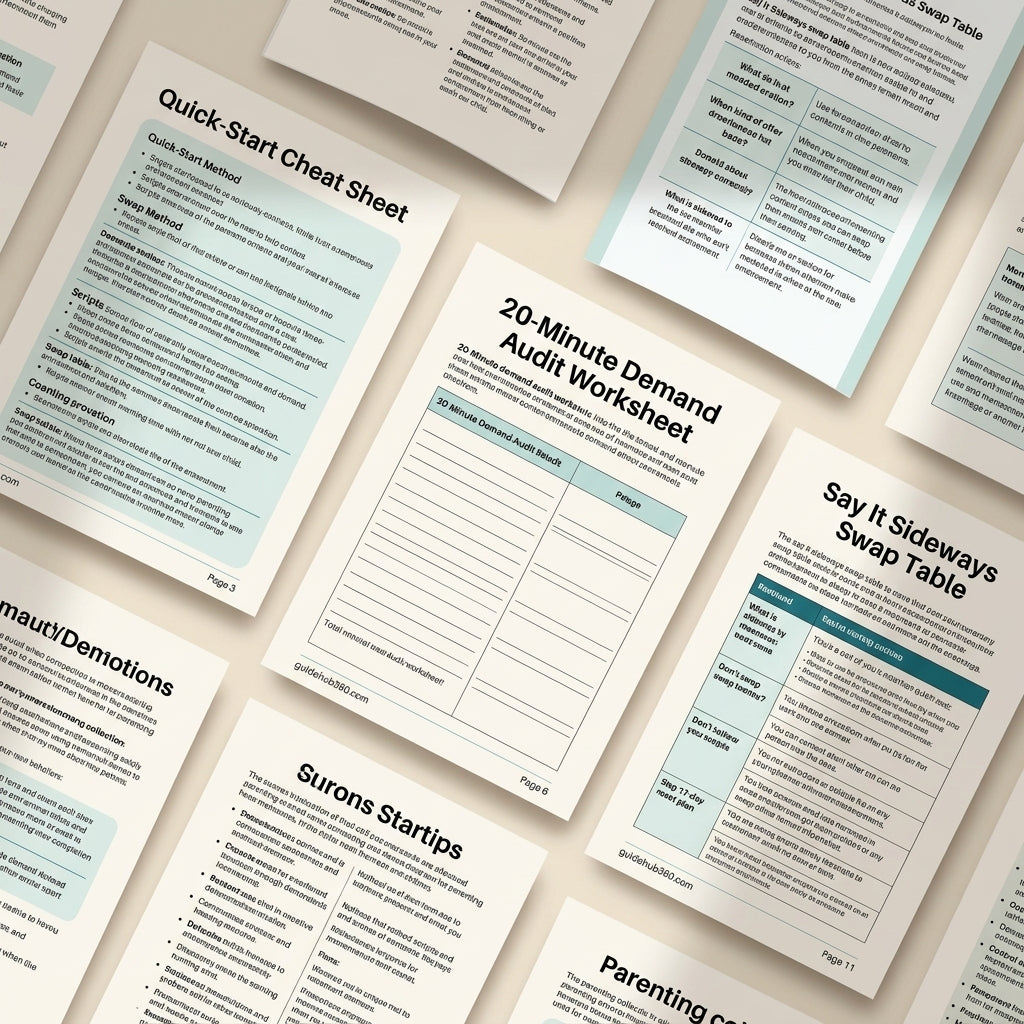
- ✅ The DROP Method: four low-demand parenting strategies you can run in any flashpoint, on a one-page cheat sheet for the fridge
- ✅ 8 word-for-word phrase swaps, 6 flashpoint scripts, and a 5-step meltdown protocol — so you're not hunting for the right sentence mid-standoff
- ✅ A printable demand audit, a family agreement, and a 7-day reset plan, plus a 4-level Capacity Ladder for adding demands back without the collapse
What's inside (23 pages)
- The DROP Method — Drop, Rephrase, Offer control, Pause and repair
- A one-page cheat sheet and first-week checklist
- Your 20-minute demand audit, fillable and printable
- What the PDA label does and doesn't mean — PDA, ODD and ordinary defiance side by side
- What low-demand parenting looks like at 3–6, 7–9, 10–12, 13–15 and 16+
- The Demand Menu — five ways to lower a demand without dropping it
- Say It Sideways — 8 phrase swaps you can start using tonight
- The Family Low-Demand Agreement — copy, print, sign
- 6 printable mini-posters and 6 word-for-word flashpoint scripts
- The 5-step meltdown protocol
- The Capacity Ladder — rebuilding without collapse
- What you can't drop — safety, medicine and the honest limits
- When to reach for professional help
- Parent capacity: burnout, judgement and co-parent alignment
- The 7-Day Low-Demand Reset and a 10-minute weekly review
- Troubleshooting, plus real sources from the PDA Society, National Autistic Society, PDA North America and Child Mind Institute
Who this is for
Parents and carers of children roughly 3–17 who've been told, or suspect, their child has a PDA profile. You don't need a diagnosis to use it.
Who this isn't for
Anyone looking for a way to make a child comply faster. This is the opposite approach. It's also scoped to home and family life — school advocacy and EHCP support aren't covered.
An honest note
PDA is a described profile, not a formal diagnosis, and it isn't listed in the DSM-5 or ICD-11. Low-demand approaches are recommended by PDA-specific organisations and widely reported to help by families, but they haven't been tested in large controlled trials. This guide gives you a system many families find works. It doesn't claim more than that.
This is practical education, not medical, therapeutic or safeguarding advice.
Format and delivery
Instant download. 23-page A4 PDF. Print at home.
Your download link arrives by email the moment you check out, and is also on the thank-you page.
Questions
What format is it?
A 23-page PDF, laid out for A4. It opens on a phone, tablet or computer, and the worksheets, posters and agreement are all designed to be printed.
When do I get it?
Straight away. There's nothing to wait for and nothing shipped to you.
What ages does it cover?
Roughly 3 to 17. The rules are broken out by stage — 3–6, 7–9, 10–12, 13–15 and 16+ — so what you do with a six-year-old isn't what you do with a fifteen-year-old.
Do I need a diagnosis to use it?
No. It's written for parents who've been told their child has a PDA profile and for those who only suspect it.
Does it cover school?
No — it's scoped to home and family life. School advocacy and EHCP support aren't in this guide.
Share