Guide Hub 360
No More Repeating Yourself
No More Repeating Yourself
Couldn't load pickup availability
You said it three times. Shoes, coat, bag. She is standing right in front of you, and two of the three did not land. By Thursday you are saying it louder, and by Friday you have started to wonder whether it is her hearing, her attitude, or you.
It is usually none of those. Holding a three-part instruction in mind while doing something else is a skill, and it is still under construction in a child of four, of eight, and of twelve.
What this guide does
It replaces the nagging with a ten-minute game. You stop deciding in the moment what to try next — the guide tells you which of the three skills is actually struggling, gives you the games matched to it, and shows you when to make them harder. No drills, no worksheets, no extra homework.
Why You Need This Guide:
- ✅ 44 working memory, impulse control, and flexible thinking activities for kids aged 4–12 — every one playable in ten minutes, with things you already have at home
- ✅ A 10-minute Spotter worksheet that shows you which of the three skills to build first, so you stop guessing and start where the friction actually is
- ✅ Stop nagging your child to concentrate — ten minutes of play most days builds the skill that nagging can't
- ✅ Word-for-word scripts for the hard moments: the refusal, the tears after losing, the "I'm just bad at this" — so you're not searching for the right words mid-meltdown
- ✅ A 7-day kickstart, a four-week printable tracker, and a signable family game agreement, so the habit survives past week one
What's inside
23 pages, built around one named system — the Play Loop: Spot → Play → Stretch → Swap.
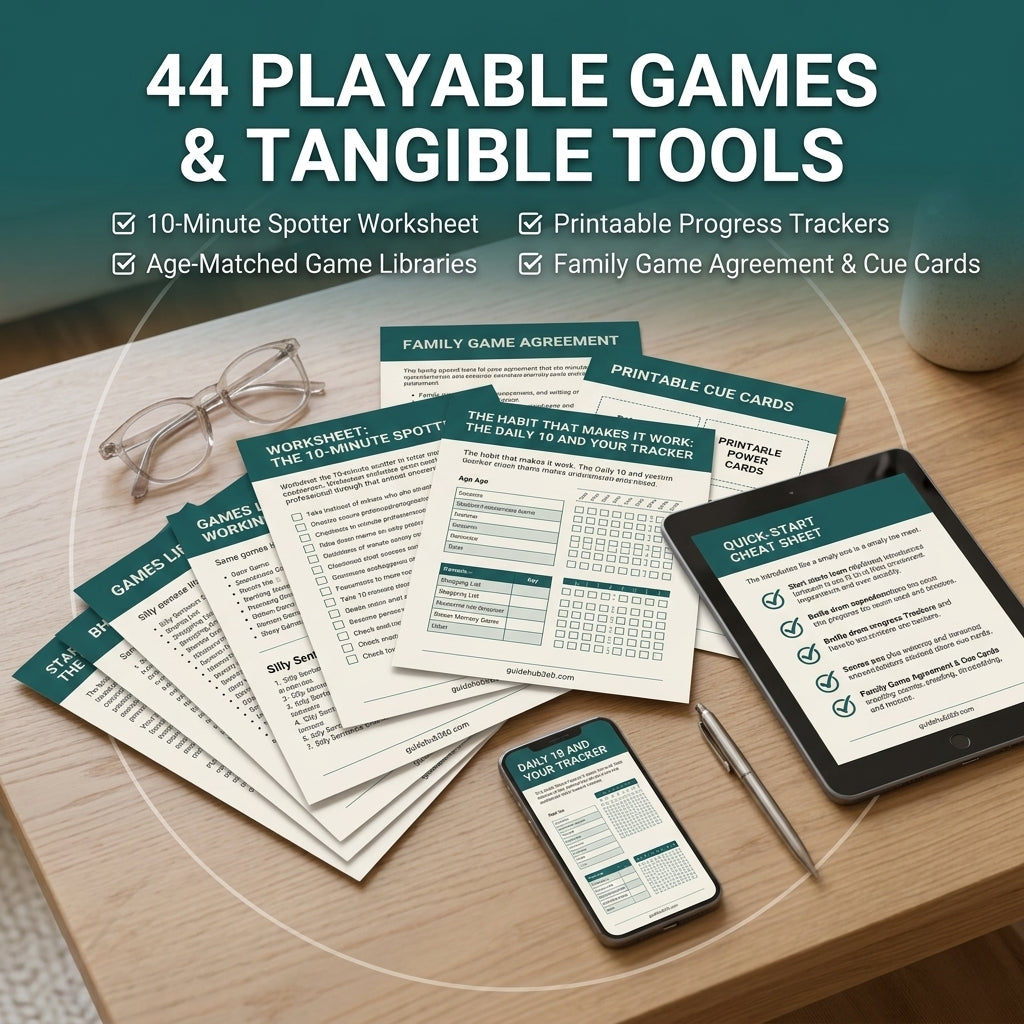
- The Spotter worksheet — a ten-minute, no-judgment diagnostic that points you at one skill, not all three
- Four game libraries, 44 games — 12 working memory, 12 impulse control, 12 flexible thinking, and 8 no-prep games for car journeys and supermarket queues
- An age-band table — your role, session length, and what actually works at 4–6, 7–9, 10–12, and 13+
- Six stretch levers — how to make any game in the book harder by exactly one step, without tipping it into refusal
- The Daily 10 and a four-week printable tracker — ten minutes anchored to something already in your day
- A 7-day kickstart — one small action a day, ending with a single decision: stretch, or swap?
- The Family Game Agreement — copy, print, sign
- Six printable cue cards — one-line prompts for the fridge, the dashboard, the bedroom door
- Six scripts for the hard moments — lines to say out loud, not ideas to paraphrase
- The Breakdown Protocol — a five-step way to end a game calmly when it tips into tears or temper
- A troubleshooting guide — six ways this commonly goes wrong, and what to change
- Sources and parent resources — Harvard's Center on the Developing Child, Understood.org, CHADD, the National Autistic Society, the NHS, the AAP, and Zero to Three
Who this is for
- Parents and carers of children roughly 4–12 who are tired of repeating themselves
- Anyone whose child loses the second half of an instruction, blurts before thinking, or falls apart when the plan changes
- Families who want something they can start tonight, in ten minutes, with what is already in the house
Who this is not for
- Anyone looking for a diagnosis. This is practical education, not medical, psychological, therapeutic, or educational assessment advice
- Anyone wanting academic drills or worksheets — this is deliberately the opposite
- Parents of teenagers only. 13+ is covered in the age table, but the games are built for 4–12
Format and delivery
A 23-page A4 PDF, designed to be read on a phone or printed. Instant download after checkout — no waiting, nothing shipped. The worksheet, tracker, agreement, and cue cards are all built to print.
Questions parents ask
What format is it, and can I print it?
An A4 PDF, 23 pages. It reads well on a phone and prints cleanly. The worksheet, four-week tracker, family agreement, and cue cards are designed for printing.
How do I get it?
Instantly. You will get a download link on the confirmation page and by email as soon as you check out.
My child is 4. My other one is 11. Does one guide cover both?
Yes. Every game carries its own age range, and the age-band table sets your role and the session length for 4–6, 7–9, 10–12, and 13+. There is also a note on what not to do when siblings of different ages are in the room together.
How much time does this actually take?
Ten minutes, most days — four sessions a week beats seven. The guide is explicit that you should borrow a slot you already have rather than invent a new one.
Is this for children with ADHD or autism?
The guide is non-diagnostic and written for any child in the age range. It does point to CHADD and the National Autistic Society in the resources section, but it is not a substitute for assessment or professional support.
What if I change my mind?
Because this is an instant digital download, please read the description carefully before buying. If something is wrong with your file or your link, email hello@guidehub360.com and we will sort it out.
Share